Across Glaciers, Vineyards, and Alpine Passes: Switzerland’s Most Remarkable Train Journeys
Few rail journeys anywhere on Earth deliver such dramatic geographical contrasts in a single day.
The Bernina Express links the Engadin region of Graubünden with the Italian town of Tirano, traversing the UNESCO World Heritage-listed Rhaetian Railway. Along the route, passengers travel from high Alpine landscapes dominated by glaciers and mountain lakes to valleys where palm trees begin to appear. Official Swiss tourism authorities describe it as a route connecting northern Europe with southern climates through some of the Alps’ most spectacular scenery.
Among its most celebrated landmarks are the Landwasser Viaduct, the Bernina Pass, Lago Bianco, Alp Grüm, and the famous Brusio Circular Viaduct, where the train loops gracefully through a spiral structure to manage steep elevation changes.
What makes the Bernina Express exceptional is not simply the scenery but the constant transformation of the landscape. The train seems to travel through several countries’ worth of geography despite remaining on a single route.
Switzerland’s Grand Alpine Crossing: Glacier Express
If the Bernina Express is a dramatic visual journey, the Glacier Express is an immersive Alpine expedition.
Operating between Zermatt and St. Moritz, the train crosses the heart of the Swiss Alps over approximately eight hours. It passes through 91 tunnels and crosses 291 bridges while connecting two of Switzerland’s most famous mountain destinations.
The route traverses multiple cantons and landscapes, including the Oberalp Pass and the Rhine Gorge, often referred to as Switzerland’s Grand Canyon. Massive panoramic windows allow passengers to follow the changing scenery without interruption.
Unlike shorter scenic routes, the Glacier Express unfolds slowly. Forests give way to mountain meadows, villages emerge beneath towering peaks, and river valleys gradually open into high Alpine terrain. The experience is less about a single iconic viewpoint and more about understanding the scale and diversity of the Swiss Alps.
Its nickname—the world’s slowest express train—captures the spirit of the journey perfectly. Speed is irrelevant when the landscape is the main attraction.
The Route That Reveals Switzerland’s Cultural Divide: GoldenPass Express
Many visitors think of Switzerland primarily as a mountain nation. The GoldenPass Express reveals something more complex.
Traveling between Interlaken and Montreux, the route links German-speaking and French-speaking Switzerland while passing through dramatically different cultural and geographic regions. Switzerland Tourism highlights the journey as one of the country’s most important panoramic rail experiences.
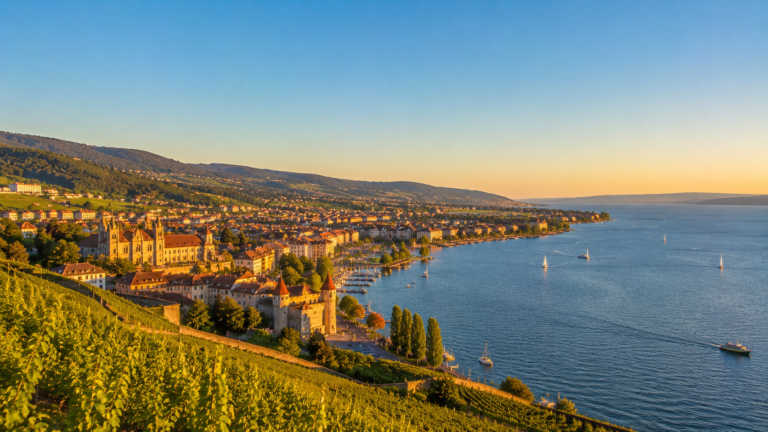
The train departs the Bernese Oberland’s mountain landscapes before descending toward Lake Geneva. Along the way, travelers encounter traditional chalet villages, rolling pastures, luxury resorts such as Gstaad, and eventually the vineyard-covered slopes overlooking one of Europe’s largest lakes.
What distinguishes the GoldenPass experience is variety. While many Swiss rail journeys focus on high mountains, this route combines lakes, villages, vineyards, and cultural transitions into a single seamless journey.
For travelers seeking the broadest picture of Swiss life, few rail routes offer a more revealing perspective.
History on Rails: Gotthard Panorama Express
Long before modern tunnels transformed Swiss transportation, the Gotthard route served as one of Europe’s most important Alpine crossings.
The Gotthard Panorama Express follows that historic story. Combining a boat journey on Lake Lucerne with a train ride through the original Gotthard mountain route, it connects Central Switzerland with the Italian-speaking canton of Ticino.
Unlike routes focused purely on scenery, this journey blends history, engineering, and geography. Travelers witness how Switzerland overcame some of Europe’s most challenging terrain long before modern infrastructure existed.
The route showcases old tunnels, historic railway architecture, mountain valleys, and dramatic views that explain why the Gotthard corridor played such an important role in the country’s economic development.
For railway enthusiasts, it is among Switzerland’s most rewarding experiences.
Lake Country and Mountain Passes: Luzern–Interlaken Express
Not every memorable Swiss train journey requires a full day.
The Luzern–Interlaken Express connects two of Switzerland’s most visited destinations while crossing some of the country’s most picturesque central landscapes. Switzerland Tourism and SBB regularly highlight it as one of the nation’s premier panoramic routes.
The route passes lakes, forests, waterfalls, and mountain villages while climbing the Brünig Pass. Large panoramic windows ensure uninterrupted views throughout the journey.
Its appeal lies in balance. It delivers mountain scenery, traditional Swiss countryside, and lakeside landscapes without requiring the extended travel time of longer Alpine crossings.
For many visitors, it becomes an ideal introduction to Swiss rail travel.
The Underrated Experience: Voralpen-Express
Some of Switzerland’s finest landscapes are found away from the country’s highest peaks.
The Voralpen-Express connects Lucerne and St. Gallen through rolling foothills, farmland, orchards, and traditional rural communities. Switzerland Tourism describes it as an opportunity to discover a gentler side of the country beyond the famous four-thousand-meter summits.
The route crosses impressive viaducts and provides frequent views of the Alps rising in the distance. Instead of dramatic mountain passes, travelers experience the everyday landscapes that have shaped Swiss culture for centuries.
It is particularly appealing for photographers seeking scenes of rural Switzerland rather than iconic tourist landmarks.
Steam, Heritage, and Alpine Engineering: Furka Mountain Steam Railway
Not all great Swiss train journeys belong to the modern era.
The Furka Mountain Steam Railway preserves one of the most historic sections of Alpine rail travel. Operating with restored steam locomotives, it climbs through high mountain terrain near the Rhône Glacier, providing a rare opportunity to experience rail travel much as it existed generations ago.
The journey is slower and less polished than modern panoramic trains, but that is precisely its charm.
Passengers hear the locomotives work against steep gradients, smell coal and steam, and experience mountain railroading in a way impossible on contemporary routes.
It is less a transportation service than a living museum.
Why Swiss Train Journeys Stand Apart
Many countries offer scenic railways. Switzerland offers an integrated scenic rail network.
The country’s panoramic routes connect seamlessly with regional trains, mountain railways, lake steamers, and urban transportation systems. This allows travelers to combine multiple iconic journeys into larger itineraries such as the Grand Train Tour of Switzerland, which links many of the nation’s most celebrated rail experiences into a single cross-country adventure.
What ultimately distinguishes Swiss train travel is the relationship between landscape and engineering. The trains are not separate from the scenery—they are part of it. Viaducts leap across ravines, tracks cling to mountainsides, tunnels emerge into sweeping panoramas, and stations appear in places that seem almost impossible to reach.
For travelers exploring Switzerland, the question is rarely whether to take a scenic train.
It is deciding which extraordinary route to board first.