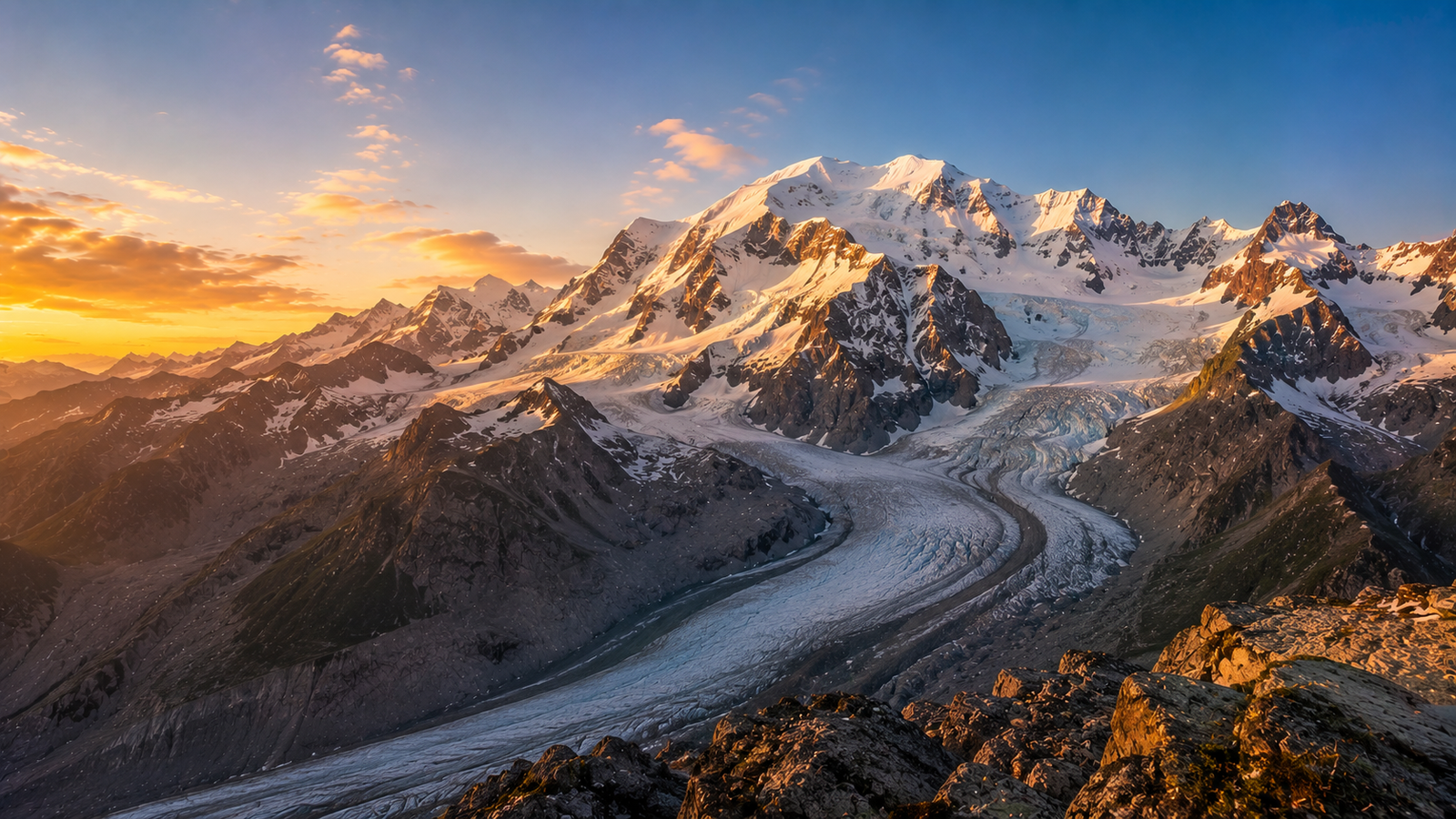
Monte Rosa (Dufourspitze), Zermatt, Switzerland
Monte Rosa and Dufourspitze: Switzerland’s Highest Summit Above the Clouds
Towering above the glaciers and high valleys of southern Switzerland, Monte Rosa is one of the most extraordinary mountain landscapes in Europe. At its highest point stands Dufourspitze, the tallest summit entirely within Switzerland and one of the most prestigious peaks in the Alps. Rising above an immense world of ice, snow, and rock, the mountain represents the ultimate expression of Alpine grandeur.
While nearby Matterhorn often attracts the spotlight for its distinctive shape, Monte Rosa impresses through scale. Its vast massif dominates the horizon east of Zermatt, creating an expansive mountain kingdom of glaciers, ridges, and summits that stretches across the Swiss-Italian border. For mountaineers, nature enthusiasts, and travelers seeking the most dramatic Alpine scenery, Monte Rosa remains one of Switzerland’s defining natural landmarks.
The Highest Point in Switzerland
Dufourspitze rises to 4,634 meters above sea level, making it the highest peak located entirely within Swiss territory. It forms part of the Monte Rosa massif, a vast mountain group containing numerous peaks exceeding four thousand meters.
Located in the Pennine Alps along the border between Switzerland and Italy, Monte Rosa occupies a commanding position above the canton of Valais. The massif is so extensive that it resembles an entire mountain range rather than a single peak.
From many viewpoints around Zermatt and the surrounding valleys, visitors can see its enormous snow-covered slopes extending across the horizon. The mountain’s sheer scale distinguishes it from many other Alpine summits and contributes to its reputation as one of Europe’s great mountain landscapes.
A Mountain Named for Exploration
The story of Monte Rosa is deeply connected to the history of Alpine exploration.
During the nineteenth century, the Alps became a focus of scientific research and mountaineering achievement. Explorers and climbers sought to reach increasingly challenging summits, transforming mountain travel into a significant chapter of European history.
Dufourspitze was named after Guillaume-Henri Dufour, a Swiss military officer, engineer, and cartographer whose contributions to Swiss topography were highly influential. The naming of Switzerland’s highest summit reflected the importance of accurate mapping and scientific understanding during a period of growing interest in the Alpine world.
Early ascents of Monte Rosa helped establish the region as a center of mountaineering, attracting climbers from across Europe and beyond.
Geography on a Grand Scale
Monte Rosa stands within one of the most heavily glaciated regions of the Alps.
Massive ice fields surround the mountain, feeding some of the largest glaciers in Switzerland. The landscape is characterized by sweeping snowfields, towering ridges, deep crevasses, and high-altitude plateaus that create a dramatic environment unlike almost anywhere else in the country.
The mountain’s geography has been shaped by glaciers over thousands of years. Ice continues to influence the terrain, carving valleys and contributing to the rugged beauty of the surrounding landscape.
The enormous scale of the massif becomes especially apparent when viewed from elevated locations such as Gornergrat, where visitors can observe the vast network of glaciers spreading outward from the mountain’s flanks.
The View from Gornergrat
For many travelers, the most memorable encounter with Monte Rosa comes from Gornergrat, one of Switzerland’s most celebrated panoramic viewpoints.
Accessible by the historic Gornergrat Railway from Zermatt, the ridge offers extraordinary views of Monte Rosa and the surrounding glaciers. From this vantage point, the mountain dominates the eastern horizon, revealing its immense size and complex network of peaks.
The Gorner Glacier, one of the largest glacier systems in Switzerland, unfolds below the viewpoint, creating a dramatic foreground for the towering summit beyond.
The combination of glaciers, snow-covered peaks, and high-altitude scenery makes this one of the most photographed mountain panoramas in the Alps.
A World for Mountaineers
Monte Rosa occupies a special place in mountaineering culture.
Unlike more accessible tourist summits, Dufourspitze remains a serious Alpine objective requiring technical skill, physical preparation, and appropriate equipment. Its high altitude and glaciated terrain make it a challenging climb even for experienced mountaineers.
The mountain’s reputation has attracted generations of climbers seeking to stand atop Switzerland’s highest peak. Routes across glaciers and ridges provide some of the Alps’ most demanding and rewarding mountaineering experiences.
Although most visitors will not attempt an ascent, the mountain’s climbing heritage contributes significantly to its mystique and international reputation.
Experiencing the Region Without Climbing
Fortunately, travelers do not need mountaineering experience to appreciate Monte Rosa.
The surrounding region offers numerous opportunities to enjoy the mountain from safe and accessible locations. Scenic railways, hiking trails, and observation platforms provide exceptional perspectives of the massif and its glaciers.
Zermatt serves as the primary gateway to the area and offers convenient access to mountain transportation networks. Hiking routes around Gornergrat and nearby alpine areas reveal changing views of Monte Rosa throughout the day.
Photographers often find the mountain especially captivating during sunrise and sunset, when warm light highlights the textures of snowfields and rocky ridges.
Seasonal Transformations
Monte Rosa presents a different character with each season.
Summer brings longer daylight hours and accessible hiking trails in the surrounding region. Alpine meadows bloom at lower elevations while the highest parts of the mountain remain covered in snow and ice.
Autumn often offers exceptionally clear visibility. Cooler temperatures and stable atmospheric conditions can produce remarkable mountain views.
Winter transforms the landscape into a vast frozen wilderness. Snow blankets the surrounding valleys and glaciers, creating some of Switzerland’s most dramatic winter scenery.
Spring introduces seasonal change in lower areas while the summit region remains firmly within a high-altitude Alpine environment.
These seasonal variations ensure that the mountain remains visually compelling throughout the year.
Wildlife and Natural Environment
The Monte Rosa region supports a variety of Alpine ecosystems.
Lower elevations contain forests, alpine meadows, and mountain habitats where wildlife has adapted to challenging environmental conditions. As altitude increases, vegetation becomes increasingly sparse, giving way to snowfields and glaciers.
This transition from green valleys to permanent ice creates striking contrasts that define the region’s natural beauty. Visitors moving through different elevations experience dramatic changes in scenery within relatively short distances.
The mountain’s environmental significance extends beyond tourism, contributing to scientific understanding of Alpine ecosystems and glacial landscapes.
Cultural Importance in the Alps
Monte Rosa is more than a geographic landmark; it is an important part of Alpine identity.
For communities in Valais and neighboring regions, the mountain has long served as a defining feature of the landscape. Its presence influences local culture, tourism, transportation, and regional heritage.
The massif also symbolizes Switzerland’s longstanding connection with mountain exploration and outdoor adventure. Images of Monte Rosa frequently appear in travel photography, mountaineering publications, and promotional materials celebrating the Swiss Alps.
Its role as Switzerland’s highest peak ensures continued fascination among visitors from around the world.
Planning a Visit
The easiest base for exploring Monte Rosa is Zermatt, one of Switzerland’s best-known mountain destinations. The village provides access to railways, hiking routes, and observation points that showcase the mountain from multiple perspectives.
Weather conditions at high altitude can change rapidly, making flexible planning essential. Visitors should dress in layers and prepare for cooler temperatures even during summer months.
Among the many great mountains of Europe, Monte Rosa stands apart because of its combination of height, scale, and glacial beauty. Whether viewed from Gornergrat, photographed from a mountain trail, or admired from the valleys below, Dufourspitze and the Monte Rosa massif represent the highest expression of Switzerland’s Alpine landscape—a place where immense glaciers, soaring peaks, and centuries of mountaineering history come together in one extraordinary setting.