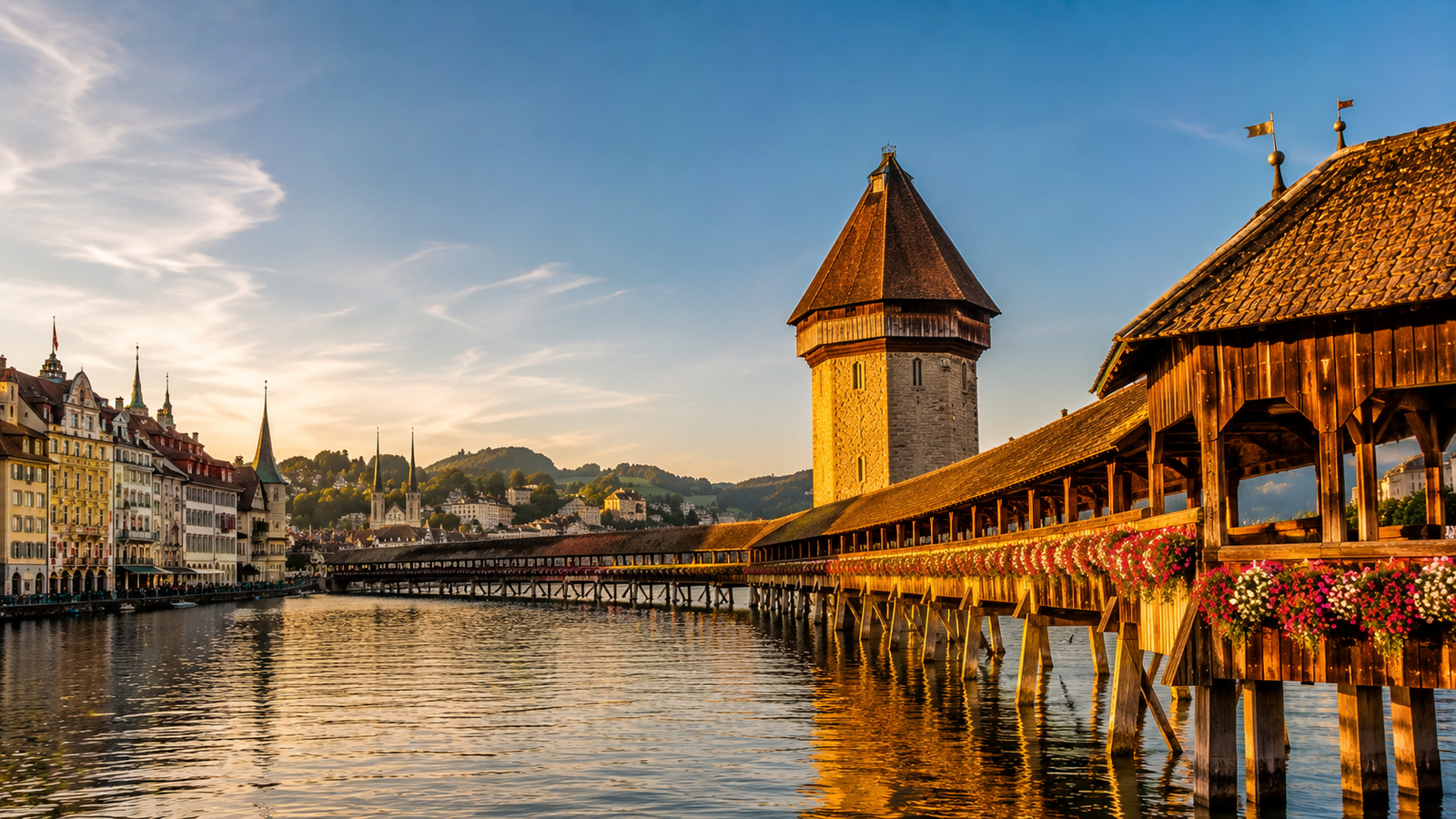
Chapel Bridge (Kapellbrücke), Lucerne, Switzerland
Chapel Bridge: The Wooden Landmark That Defines Lucerne
Few places in Switzerland are photographed as often as Chapel Bridge, known locally as Kapellbrücke. Stretching diagonally across the Reuss River in the heart of Lucerne, the covered wooden bridge has become one of the country’s most enduring symbols. Visitors arriving in the city often encounter it within minutes, yet the bridge offers far more than a picturesque view.
For centuries, Chapel Bridge has served as a witness to Lucerne’s transformation from a medieval settlement into one of Switzerland’s most visited destinations. Its distinctive roofline, historic paintings, and neighboring Water Tower create a scene that has come to represent Lucerne itself.
A Medieval Bridge With a Defensive Purpose
Chapel Bridge was constructed during the 14th century, most likely around 1360, at a time when Lucerne was strengthening its fortifications. Although travelers today see it as a scenic pedestrian crossing, the bridge originally played a strategic role in the city’s defenses.
The structure formed part of a larger protective system that included the city walls and nearby fortifications. Its unusual angled route across the Reuss River was not designed for aesthetics but for military purposes. Together with other defensive elements, it helped protect Lucerne from potential threats approaching the city.
The bridge takes its name from St. Peter’s Chapel, located near the northern end of the crossing. Historical references confirm that the bridge existed by the mid-14th century, making it one of the oldest surviving covered wooden bridges in Europe.
The Water Tower: Lucerne’s Silent Guardian
Standing beside the bridge is the octagonal Water Tower, a structure that predates Chapel Bridge itself. Built around the end of the 13th century, the tower has become inseparable from the identity of the bridge.
Over its long history, the Water Tower served many purposes. It functioned as part of Lucerne’s defenses, housed important municipal records, safeguarded treasures, and was even used as a prison. Today, it remains one of the most recognizable structures in Switzerland, rising dramatically above the river beside the wooden bridge.
The contrast between the dark stone tower and the timber bridge creates one of the most iconic urban landscapes in the country.
An Open-Air Gallery Above the River
What makes Chapel Bridge truly unique is the collection of triangular paintings mounted beneath its roof.
Created during the early 17th century, these artworks transformed the bridge into a visual chronicle of Swiss and Lucerne history. The paintings depict religious scenes, important historical events, and stories associated with Lucerne’s patron saints, including St. Leodegar and St. Maurice.
Rather than serving purely decorative purposes, the paintings acted as a form of public storytelling. In an era when literacy was limited, visual narratives helped communicate history, faith, and civic identity to the population.
Walking across the bridge today feels like moving through a historic gallery suspended above the water. Although many original paintings have been lost over time, the surviving panels continue to offer glimpses into the city’s cultural heritage.
The Night That Shocked Switzerland
For more than six centuries, Chapel Bridge survived floods, weather, and urban change. Then, in the early hours of August 18, 1993, disaster struck.
A devastating fire rapidly spread through the wooden structure, destroying approximately two-thirds of the bridge. Flames consumed large sections of the roof and caused severe damage to many of the historic paintings. Images of Lucerne’s beloved landmark burning circulated around the world, generating widespread public concern and sadness.
The Water Tower and portions of the bridge survived, but the destruction represented one of the most significant heritage losses in modern Swiss history.
Yet the response was equally remarkable.
Local authorities, preservation experts, and residents quickly committed to rebuilding the structure. Extensive documentation and restoration work began almost immediately. Within only eight months, Chapel Bridge was reconstructed and reopened to the public in April 1994.
Today, visitors can still identify some of the effects of the fire. Certain spaces beneath the roof remain intentionally empty where destroyed paintings were not replaced, serving as a visible reminder of the bridge’s turbulent history.
Experiencing Chapel Bridge Today
Modern visitors encounter a bridge that remains deeply integrated into everyday life in Lucerne.
Unlike many historic monuments that function primarily as tourist attractions, Chapel Bridge continues to serve as an active pedestrian route linking different parts of the city center. Residents, commuters, and travelers all share the crossing throughout the day.
The experience changes depending on the time of day.
Early mornings often provide the most peaceful atmosphere. The river reflects the surrounding buildings, the old town remains relatively quiet, and photographers can capture unobstructed views of the bridge and tower.
Later in the day, the bridge becomes livelier as visitors explore Lucerne’s historic center. The sounds of the city blend with the flowing river, creating a vibrant urban setting that reflects both tradition and modern life.
Photography and Scenic Views
For photographers, Chapel Bridge offers opportunities from nearly every angle.
One of the most popular perspectives is from the riverbanks, where the bridge and Water Tower appear together against the backdrop of Lucerne’s historic skyline. Reflections on calm water often create striking compositions, particularly during sunrise and sunset.
From within the bridge itself, visitors enjoy framed views of the Reuss River, colorful waterfront buildings, and nearby church towers. Seasonal flower displays along portions of the bridge add additional color during warmer months.
The surrounding cityscape changes throughout the year, making every visit slightly different.
Exploring Beyond the Bridge
Chapel Bridge also serves as an ideal starting point for discovering Lucerne.
A short walk leads into the Old Town, where painted facades, historic squares, and narrow streets reveal centuries of urban history. Nearby attractions include the Jesuit Church, the Musegg Wall, and the lakeside promenade along Lake Lucerne.
Because many of the city’s major sights are located within walking distance, visitors can easily incorporate Chapel Bridge into a broader exploration of Lucerne without extensive planning.
The bridge effectively acts as a gateway between the city’s medieval heritage and its modern cultural life.
More than six centuries after its construction, Chapel Bridge remains far more than a river crossing. It is a symbol of resilience, a monument to Swiss craftsmanship, and a living piece of Lucerne’s history. Whether admired from the riverbank, photographed at dawn, or crossed on foot among locals and visitors alike, Kapellbrücke continues to embody the character of one of Switzerland’s most beautiful cities.