Basel Police Block Unauthorized Demonstration Amid Security Concerns
Swiss authorities mounted a large security operation in the city of Basel on Saturday after preventing an unauthorized demonstration linked to the Israeli-Palestinian conflict from proceeding as planned, a move that intensified debate over the balance between public safety and freedom of assembly.
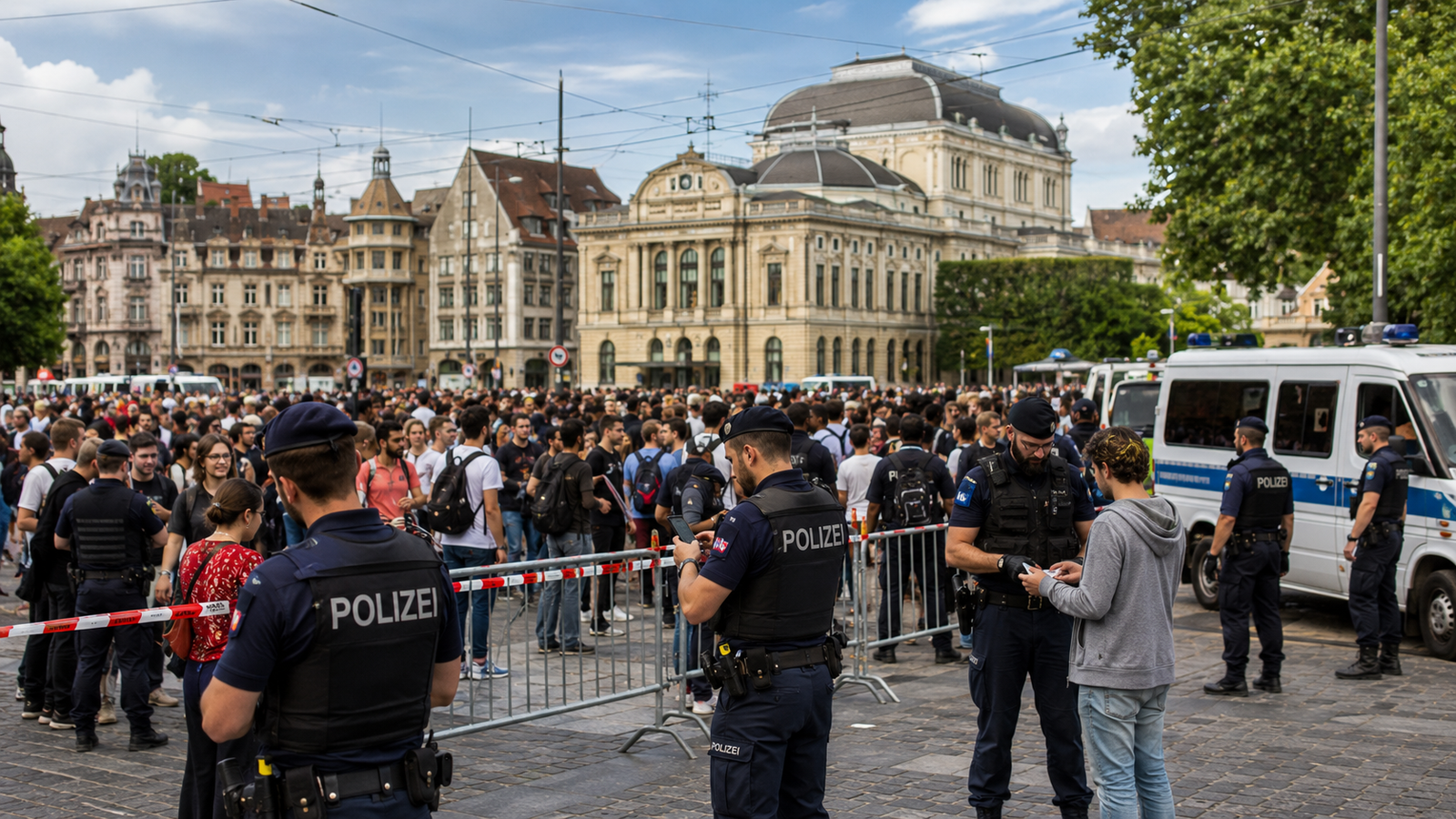
The gathering drew several hundred participants to Theaterplatz in central Basel despite prior warnings from police that the event would not be authorized. Officers deployed in significant numbers throughout the city center, ultimately surrounding a large portion of the crowd and conducting identity checks as tensions periodically rose between demonstrators and law enforcement personnel.
The demonstration had been promoted under a slogan that authorities considered incompatible with legal protections for peaceful political expression. Days before the event, Basel-Stadt Cantonal Police publicly announced that the planned protest could not receive authorization because officials believed its advertised messaging included explicit calls to violence. Authorities also stated that protecting the safety of the city’s Jewish community was a key consideration in their preparations.
By early afternoon on Saturday, between 200 and 300 people had assembled at Theaterplatz. Participants chanted pro-Palestinian slogans and carried signs expressing opposition to Zionism. Police units, supported by a water cannon and officers from neighboring cantons, maintained a strong presence around the square while monitoring developments.
According to authorities, police initially attempted to engage organizers and participants through mediation teams. Officials later reported that efforts to establish dialogue were unsuccessful. Investigators said some participants appeared to be preparing for a march through the city center despite warnings that such a procession would not be permitted. Police subsequently moved to contain the gathering and prevent it from leaving the designated area.
Witness accounts described a tense atmosphere as officers gradually tightened the security perimeter around demonstrators. Small groups remained outside the cordoned area, and occasional confrontations developed along police lines. Law enforcement confirmed that pepper spray was used during at least one incident involving resistance to police instructions. Authorities stated that no other crowd-control measures were deployed during the operation.
The demonstration’s timing carried symbolic significance. Organizers had called for the protest to coincide with the anniversary of the opening of the First Zionist Congress, which took place in Basel in 1897 and is widely regarded as a foundational event in the history of modern political Zionism. The anniversary has periodically attracted both commemorative events and political demonstrations reflecting differing views on the Israeli-Palestinian conflict.
Following the operation, police released additional details regarding enforcement actions. Authorities said 174 individuals were subjected to identity checks and ordered to leave the area. One person was arrested on the basis of an unrelated detention warrant, while at least four others faced allegations connected to obstructing official police duties. Two minors were temporarily held until they could be released to their parents.
Police also reported the seizure of several items during searches conducted after the demonstration was contained. According to official statements, officers recovered a baton, protective goggles, face-covering materials, and propaganda material displaying Hamas-related symbols. Authorities have not indicated that these discoveries resulted in broader criminal investigations beyond the immediate enforcement actions announced Saturday night.
The operation had a noticeable impact on central Basel. Major roads around Theaterplatz and nearby intersections remained closed for approximately eight hours while officers maintained control of the area and completed security procedures. Authorities later acknowledged the disruption and thanked residents for their patience during the extended police presence.
The incident unfolded against a backdrop of heightened political tensions across Europe related to the ongoing conflict in the Middle East. Swiss cities, including Basel, have experienced numerous demonstrations by groups expressing solidarity with Palestinians as well as events supporting Israel. Authorities have increasingly faced the challenge of safeguarding constitutional rights while responding to concerns about public order, hate speech, and potential threats against minority communities.
Switzerland traditionally places strong emphasis on freedom of expression and the right to peaceful assembly. However, those rights are not unlimited under Swiss law. Officials maintain that demonstrations can be restricted when authorities determine that public safety risks or direct incitement to violence are involved. The Basel case is likely to attract continued discussion regarding where those legal boundaries should be drawn and how they should be enforced in politically sensitive situations.
For now, the immediate focus remains on the events of Saturday and the decisions made by authorities before and during the gathering. While no large-scale violence occurred, the operation highlighted the increasingly complex security environment surrounding demonstrations connected to international conflicts. The outcome also underscored the determination of Basel authorities to prevent events they consider unlawful while maintaining control of one of Switzerland’s most internationally recognized cities.