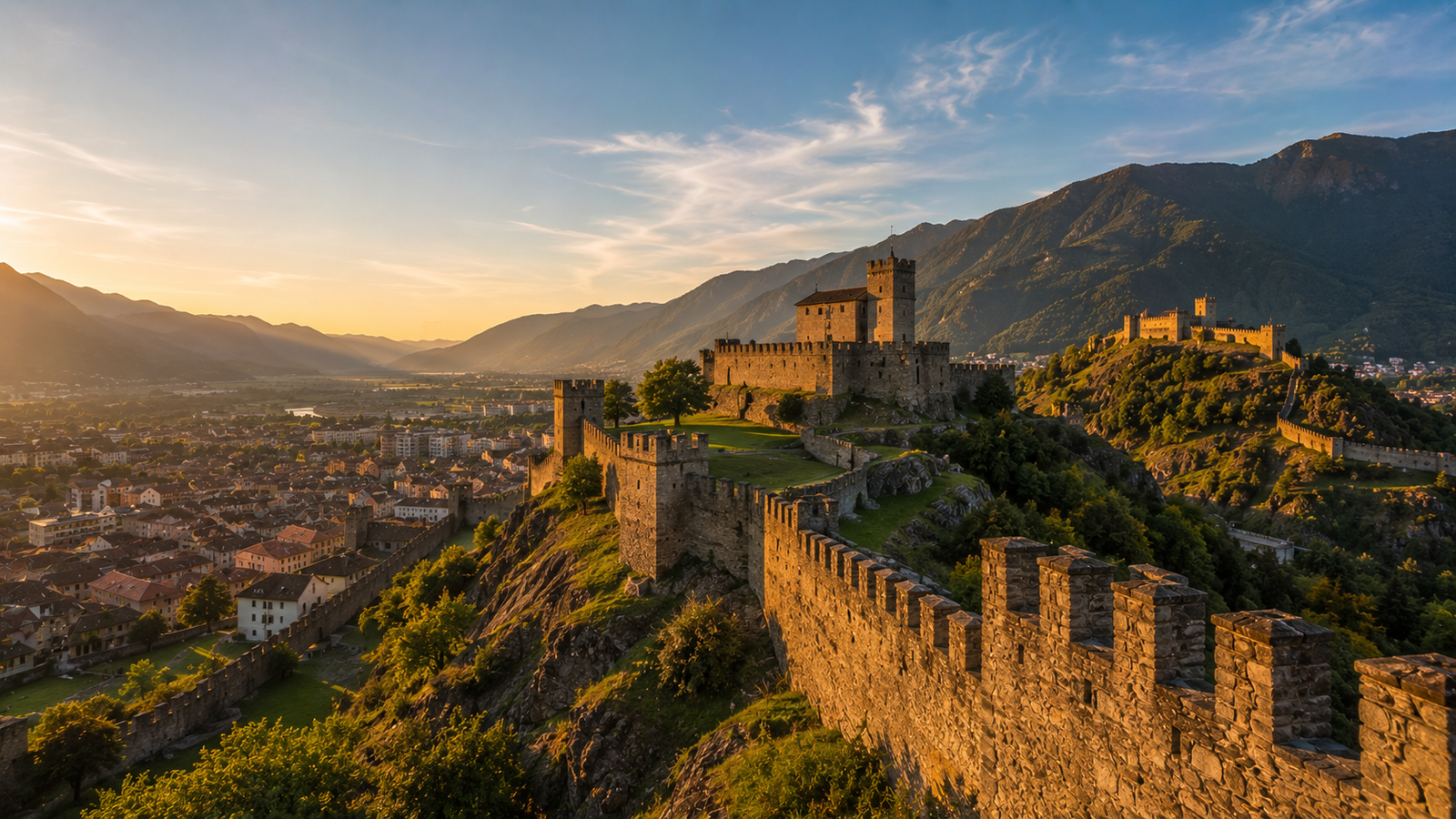
Bellinzona Fortress Walls, Bellinzona, Switzerland
Bellinzona Fortress Walls: The Medieval Defenses That Guarded the Alps
Travelers arriving in Bellinzona often notice the castles first. Rising above the city on rocky hillsides, the fortifications dominate the skyline and immediately reveal the strategic importance of this southern Swiss crossroads. Yet the castles tell only part of the story. Connecting them was a remarkable defensive network of walls, gates, towers, and barriers that transformed Bellinzona into one of medieval Europe’s most formidable strongholds.
Today, the Bellinzona Fortress Walls remain among the most significant military monuments in Switzerland. Together with the city’s three castles—Castelgrande, Montebello, and Sasso Corbaro—they form a UNESCO World Heritage Site recognized for its exceptional example of late medieval military architecture.
For visitors, the walls offer far more than historical ruins. They provide insight into centuries of political rivalry, control of key Alpine trade routes, and the strategic geography that shaped the history of southern Switzerland.
Why Bellinzona Became So Important
To understand the fortress walls, it is necessary to understand Bellinzona’s location.
The city sits at a crucial junction where routes from several major Alpine passes converge before continuing south toward the Italian plains. For centuries, merchants, armies, pilgrims, and travelers moving between northern and southern Europe passed through this narrow corridor.
Geography made Bellinzona both valuable and vulnerable.
Steep mountains surround the valley, creating a natural bottleneck that could be controlled by whoever held the surrounding heights. Long before modern national borders existed, regional powers recognized the military and economic importance of this position.
As a result, Bellinzona became a heavily contested frontier town throughout the Middle Ages.
Building a Defensive Barrier Across the Valley
Unlike many castle complexes that relied solely on elevated strongholds, Bellinzona developed a far more ambitious defensive strategy.
Military planners combined natural terrain with extensive stone fortifications to create a system capable of controlling movement through the valley. Defensive walls extended from the castles and, at various periods, stretched across much of the valley floor.
The most notable example was the Murata, a massive fortified wall that extended from Castelgrande toward the Ticino River. Historical records indicate that this structure effectively created a barrier across the valley, making it difficult for hostile forces to bypass the city’s defenses.
The design reflected a sophisticated understanding of medieval military strategy. Rather than defending a single point, Bellinzona’s fortifications controlled an entire landscape.
The Castles and the Walls: One Unified System
Visitors often explore the three castles individually, but historically they functioned as parts of a coordinated defensive network.
Castelgrande
Occupying a commanding rocky outcrop above the city center, Castelgrande forms the oldest and most strategically important part of the complex.
Archaeological evidence indicates that the site has been occupied since ancient times. Its elevated position provided extensive visibility over the surrounding valleys and allowed defenders to monitor approaching traffic.
The fortress walls associated with Castelgrande formed a critical component of the city’s wider defensive system.
Montebello Castle
Located on a hillside east of the city center, Montebello Castle added another layer of protection.
Its fortifications connected with defensive walls that helped secure vulnerable approaches to the city. The castle’s position allowed defenders to coordinate with Castelgrande while maintaining surveillance over key routes entering Bellinzona.
Many of the surviving walls visible today are associated with the development and strengthening of this sector of the defenses.
Sasso Corbaro
The highest of Bellinzona’s three castles, Sasso Corbaro occupies an isolated rocky hill overlooking the city.
Constructed during the late 15th century, it strengthened Bellinzona’s defensive capabilities during a period of regional conflict. While not directly connected by continuous walls to the lower castles, it formed an essential element of the broader defensive network.
Together, the three fortresses created overlapping zones of observation and protection.
A Frontier Between Competing Powers
The fortress walls of Bellinzona reflect a period when control of the region shifted between powerful states.
During the late medieval era, the Duchy of Milan invested heavily in strengthening Bellinzona’s defenses. The city served as a critical northern outpost protecting Milanese interests and controlling access to Alpine routes.
Many of the fortifications visible today date from this period of military expansion.
The walls were designed not merely to repel local attacks but to withstand larger military campaigns. Their scale and sophistication demonstrate the importance Milan placed on controlling this strategic gateway.
In the early 16th century, Bellinzona came under the control of the Swiss Confederation, marking a significant political transition while preserving the city’s military importance.
Walking the Fortress Landscape Today
Modern visitors experience the fortress walls very differently from medieval defenders.
Rather than serving military purposes, the preserved ramparts now provide walking routes, scenic viewpoints, and opportunities to explore centuries of architectural history.
One of the most rewarding aspects of visiting Bellinzona is the ability to move through the landscape and understand how geography influenced defense. Paths linking sections of the fortifications reveal the relationship between the castles, the city below, and the surrounding mountains.
Standing atop the walls, visitors can appreciate why this location became one of the most heavily fortified points in the Alps.
The views extend across valleys that once carried merchants transporting goods between northern Europe and Italy.
UNESCO Recognition and Preservation
In 2000, the Castles of Bellinzona, including their defensive walls and ramparts, were inscribed on the UNESCO World Heritage List.
UNESCO recognized the site as an outstanding example of a late medieval defensive complex strategically positioned to control an important Alpine route.
The designation reflects not only the quality of the surviving architecture but also the exceptional integrity of the overall defensive landscape.
Unlike isolated castle ruins, Bellinzona preserves a comprehensive system that allows historians and visitors alike to understand how medieval fortifications functioned on a regional scale.
Extensive conservation efforts have helped protect the walls and associated structures while allowing public access to significant portions of the site.
The Best Way to Experience the Walls
Many visitors begin at Castelgrande, which offers a practical introduction to the history and layout of the defensive system. From there, exploring the pathways toward Montebello Castle provides a clearer understanding of how the walls connected different strategic positions.
Photographers often find the most striking perspectives from elevated sections of the fortifications, where stone ramparts frame views of Bellinzona’s historic center and the surrounding Ticino landscape.
Morning and late-afternoon light can be particularly rewarding, highlighting the textures of the ancient masonry and the dramatic topography that shaped the city’s history.
The fortress walls are especially fascinating because they reveal a broader story than any single castle could tell. They demonstrate how medieval engineers adapted architecture to geography, transforming a mountain valley into one of Europe’s most effective defensive corridors.
For travelers interested in history, architecture, or the evolution of Alpine trade routes, Bellinzona’s fortress walls provide a rare opportunity to walk through a defensive landscape that once stood at the crossroads of European power. Centuries after their military purpose faded, the walls continue to define the character of Bellinzona and remain among Switzerland’s most remarkable historical treasures.