Traditional Swiss Festivals Explained
A Nation That Celebrates Its Heritage
Switzerland is often admired for its Alpine scenery, precision watches, and world-famous chocolate, but one of the country’s most fascinating treasures is its living traditions. Across mountain valleys, lakeside towns, and historic cities, centuries-old festivals continue to bring communities together, preserving customs that have survived wars, political changes, and the rapid pace of modern life.
Traditional Swiss festivals offer visitors a unique window into the country’s cultural identity. They reflect the influences of Switzerland’s German, French, Italian, and Romansh-speaking regions while celebrating local history, agriculture, religion, and community spirit.
For travelers seeking experiences beyond famous landmarks, these festivals reveal a side of Switzerland that remains deeply connected to its past.
When the Mountains Come Home
One of Switzerland’s most beloved traditions takes place at the end of summer when cattle return from high Alpine pastures.
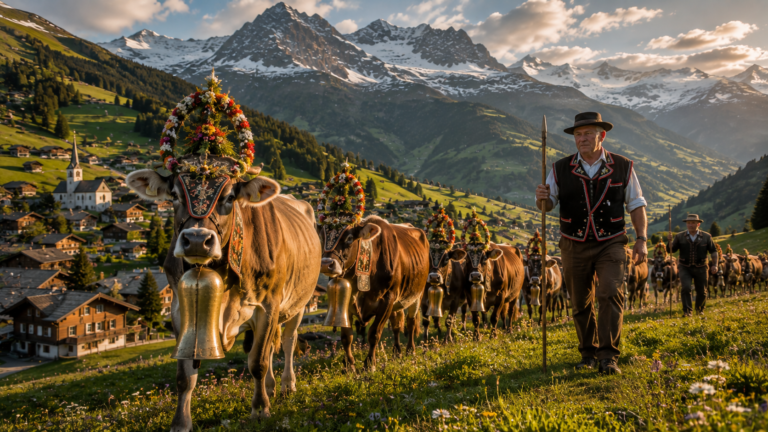
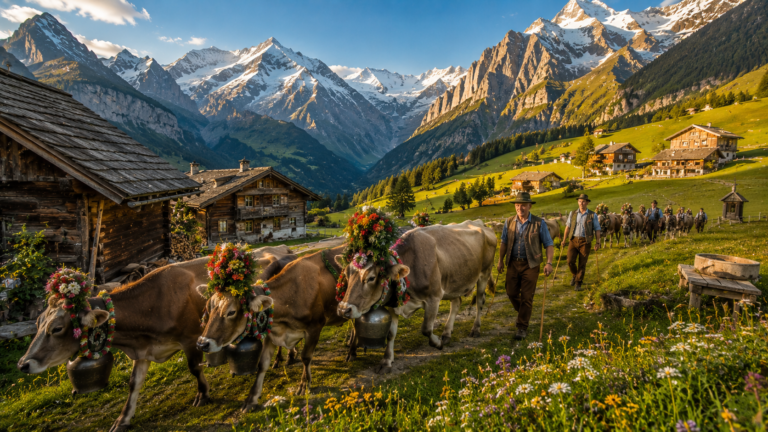
Known as Alpabzug, Désalpe, or Alpabfahrt depending on the region, this festival marks the seasonal descent of cows from mountain grazing areas to village farms. The event is both practical and ceremonial.
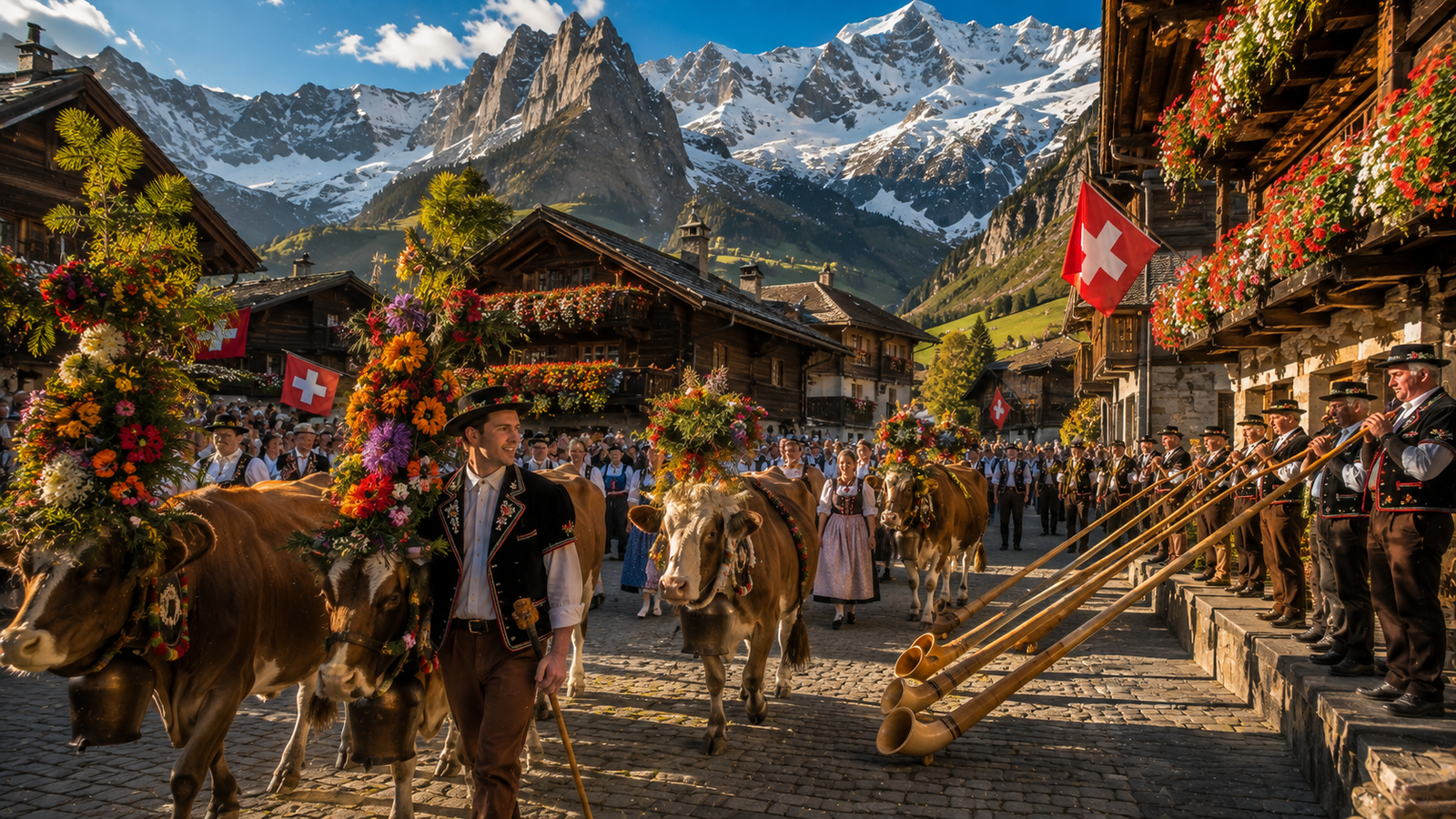
Farmers carefully decorate their finest animals with elaborate flower arrangements, colorful ribbons, and enormous ceremonial bells. Villages come alive as herds move through narrow streets accompanied by shepherds dressed in traditional clothing.
The spectacle attracts thousands of visitors each year, particularly in regions such as Appenzell, the Bernese Oberland, Gruyères, and central Switzerland.
While the event appears festive, it also highlights the importance of Alpine agriculture, which has shaped Swiss life for centuries.
The Sound of the Alps
Few sounds are more closely associated with Switzerland than the deep, resonant notes of the alphorn.
Traditional music festivals throughout the country celebrate this iconic instrument alongside yodeling, folk dancing, and regional music traditions. These gatherings often take place in spectacular mountain settings where the sound carries across valleys and meadows.
The largest events attract performers from multiple cantons, each bringing unique regional styles and costumes. Visitors witness a rich cultural landscape where traditions continue to evolve while maintaining their historic roots.
Many festivals also include demonstrations of traditional crafts, cheese-making techniques, and rural customs, creating immersive cultural experiences that extend far beyond music alone.
The Fiery Tradition of Sechseläuten
Spring arrives dramatically in Zurich with one of Switzerland’s most famous festivals.
Sechseläuten traces its origins to medieval guild traditions and marks the symbolic end of winter. The centerpiece of the celebration is the Böögg, a large snowman figure filled with fireworks.
As evening approaches, crowds gather around a massive bonfire in the city center. When the Böögg is set ablaze, spectators eagerly watch how long it takes for the head to explode.
According to popular tradition, a faster explosion predicts a warmer summer. This belief remains a cherished local custom rather than a scientifically supported forecast.
The festival also features colorful guild processions, historic costumes, marching bands, horse-drawn carriages, and ceremonial displays that transform Zurich into a living showcase of its history.
A Celebration Written Into Swiss Identity
Every year on August 1, Switzerland celebrates its National Day.
The date commemorates the Federal Charter of 1291, often regarded as one of the foundational documents in the formation of the Swiss Confederation. While historians continue to debate certain aspects of Switzerland’s early development, August 1 has become the country’s most important national celebration.
Across the nation, villages and cities organize fireworks, concerts, speeches, lantern parades, and community gatherings.
Mountain peaks are illuminated by traditional bonfires, creating dramatic scenes that connect modern Switzerland with ancient Alpine signaling traditions.
For many Swiss citizens, National Day is both a patriotic celebration and a reflection on the values of independence, cooperation, and local democracy.
The Colorful World of Basel Carnival
In northwestern Switzerland, the city of Basel hosts one of Europe’s most distinctive cultural events.
Known simply as Fasnacht, the Basel Carnival begins early on a Monday morning following Ash Wednesday. At precisely four o’clock, city lights are extinguished and thousands of masked participants fill the dark streets carrying illuminated lanterns.
What follows is a three-day celebration unlike any other in Switzerland.
Musicians playing piccolos and drums march through narrow medieval streets while elaborate costumes and artistic lanterns satirize politics, current events, and social issues.
The festival’s deep historical roots and unique traditions have earned international recognition and remain an essential part of Basel’s cultural identity.
Wrestling, Strength, and Rural Pride
Traditional Swiss festivals are not limited to music and parades.
Many celebrations feature Schwingen, the country’s distinctive form of wrestling. This sport dates back centuries and remains especially popular in rural regions.
Competitors wearing sturdy canvas shorts compete in sawdust-filled rings before enthusiastic crowds. The sport emphasizes respect, fair play, and physical skill rather than spectacle.
Large Swiss wrestling festivals often attract tens of thousands of spectators and are accompanied by folk music, local food, and cultural exhibitions.
For many Swiss people, Schwingen represents enduring rural traditions and a strong connection to national heritage.
Wine, Harvests, and Regional Traditions
Switzerland’s cultural landscape changes dramatically from one region to another.
In wine-growing areas such as Lavaux, Valais, and parts of Ticino, harvest festivals celebrate centuries of agricultural expertise. Local wines, regional cuisine, music, and historical traditions take center stage during these events.
One of the most famous examples is the Fête des Vignerons in Vevey, a spectacular winegrowers’ festival held only once every generation. Its rarity contributes to its extraordinary significance.
This celebration transforms the lakeside town into a grand stage honoring vineyard workers, agricultural traditions, and the cultural heritage of the region.
The festival demonstrates how Swiss traditions remain closely tied to local landscapes and livelihoods.
Hidden Traditions in Alpine Villages
Some of Switzerland’s most intriguing festivals occur far from major tourist routes.
Remote Alpine communities continue to preserve customs that have survived for centuries. In certain valleys, winter processions feature elaborate masks and costumes designed to symbolically drive away evil spirits or welcome seasonal change.
Elsewhere, church festivals, livestock markets, and village celebrations blend religious traditions with local folklore.
Many of these events remain deeply rooted in community life rather than tourism, giving visitors an opportunity to experience authentic cultural practices that have been passed from generation to generation.
Why These Celebrations Still Matter
In a world increasingly shaped by globalization, Switzerland’s traditional festivals continue to play an important role.
They strengthen local identities, preserve regional languages and customs, and create opportunities for communities to reconnect with their heritage. Younger generations learn traditions directly from parents and grandparents, ensuring cultural continuity.
These festivals also remind visitors that Switzerland is more than a collection of famous mountains and luxury products. Behind the postcard scenery lies a diverse nation whose traditions remain remarkably vibrant.
The enduring popularity of Swiss festivals demonstrates that heritage is not simply preserved in museums. It lives in village squares, mountain pastures, historic streets, and community gatherings where music, food, stories, and shared memories continue to bring people together.
For travelers hoping to understand the true character of Switzerland, there may be no better place to begin than among the festivals that have shaped the country’s cultural soul for centuries.