
Switzerland Expands Accessible Rail Travel, but Hundreds of Stations Still Await Upgrades
Switzerland has significantly expanded access to its railway network for travelers with disabilities, but the country remains well short of achieving full accessibility nearly three years after a legal deadline required transport operators to remove barriers across the rail system.
New figures released by the Swiss Federal Office of Transport (FOT) show that 1,168 of Switzerland’s approximately 1,800 railway stations and rail stops were accessible to people with disabilities at the end of 2025. That represents roughly 65% of the national rail network and marks continued progress in a long-running modernization effort.
Although a majority of stations now meet accessibility requirements, the data also highlights the scale of work still remaining. Hundreds of stations continue to require upgrades, despite legislation that originally required rail operators to complete accessibility improvements by the end of 2023.
The findings were published as part of the latest federal assessment of Switzerland’s implementation of disability-equality requirements for public transportation. The report evaluates the progress made under the Disability Discrimination Act, which was designed to ensure that people with reduced mobility can travel independently and without barriers.
Most Passengers Already Benefit
While only about two-thirds of stations are currently accessible, federal officials emphasize that the upgrades completed so far have focused on the busiest locations.
As a result, approximately 83% of rail passengers now use stations that provide accessible infrastructure. By 2029, authorities expect that figure to rise to around 87% as additional projects are completed.
The difference between the percentage of accessible stations and the percentage of passengers benefiting from those stations reflects a strategic approach to modernization. Major transport hubs serving large numbers of travelers were generally upgraded before smaller regional stations, allowing the greatest number of passengers to benefit from the investments.
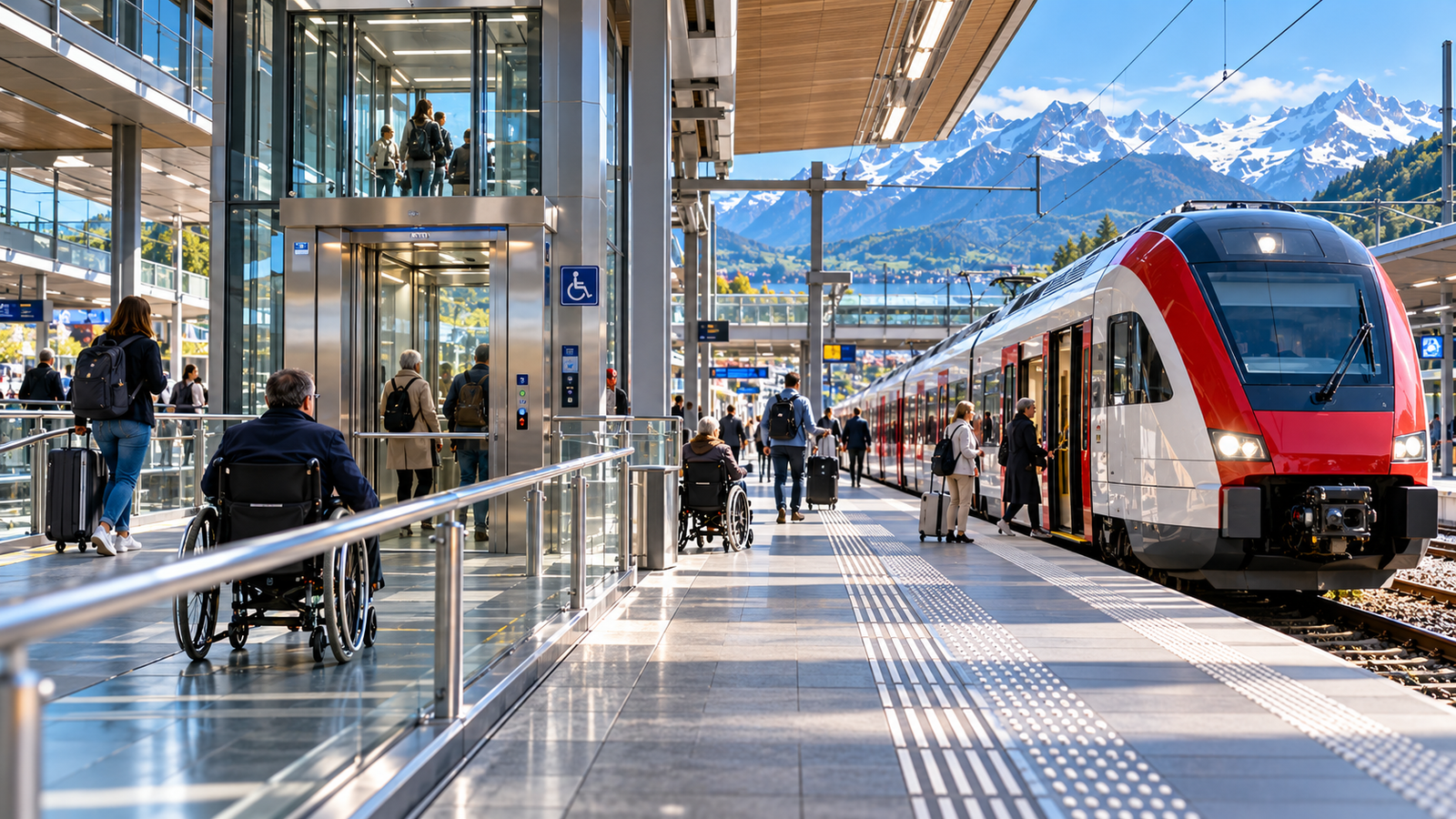
Accessibility improvements typically include raised platforms for level boarding, elevators, ramps, improved passenger information systems, tactile guidance features, and infrastructure that enables wheelchair users and people with reduced mobility to travel independently.
Delays Continue to Challenge the Program
The latest report shows that 454 railway stations still require accessibility improvements. Of those, 261 are not expected to be completed before 2029. Officials have cited planning constraints, staffing shortages, and funding challenges as major reasons for the delays.
Switzerland’s federal government has attempted to accelerate progress by allocating additional resources. Under current funding agreements covering 2025 through 2028, authorities have committed an additional CHF 250 million to support accessibility projects across the rail network.
Even with the additional funding, some stations may never undergo full structural reconstruction. According to federal assessments, roughly 150 stations are considered disproportionate or excessively costly to rebuild because of their location, passenger volumes, or engineering constraints. Instead, permanent alternative solutions will be provided.
Those alternatives can include assistance from station personnel, portable boarding equipment, or shuttle services connecting travelers to nearby accessible stations. Public transport operators across Switzerland have increasingly relied on such measures where major construction projects are not feasible.
Attention Turns to Bus Stops
For the first time, the federal report also examined accessibility across Switzerland’s extensive bus network.
The findings reveal that progress on bus infrastructure remains mixed. Switzerland has roughly 25,000 bus stops and around 48,000 boarding edges nationwide. Approximately half are currently usable by travelers with reduced mobility.
Among those accessible locations, only a small share allows fully independent boarding without assistance. Many stops still require support from drivers through the use of folding ramps or other accessibility equipment. Meanwhile, more than four in ten boarding points remain inaccessible even with staff assistance, requiring alternative transport arrangements.
Responsibility for bus stop accessibility differs from railway infrastructure. While rail operators manage station upgrades, many bus stops fall under the authority of cantonal, municipal, and local governments, adding another layer of complexity to implementation efforts.
Accessibility Beyond Compliance
Advocates and transport officials argue that accessibility improvements benefit far more than travelers with disabilities.
Older adults, passengers with strollers, people carrying luggage, and individuals recovering from injuries often benefit from elevators, ramps, step-free boarding, and clearer passenger information systems. Transport authorities have repeatedly described accessibility investments as improvements that enhance usability for the entire population.
Switzerland operates one of the world’s most heavily used rail systems, carrying millions of passengers each week. As the population ages and demand for barrier-free mobility grows, accessibility is increasingly viewed as a core component of transportation planning rather than a specialized accommodation.
Despite missing its original deadline, Switzerland has continued to make measurable progress toward a more inclusive transport network. Yet the latest figures demonstrate that substantial work remains before equal access becomes a reality across the entire rail and bus system. For now, the country’s accessibility program remains an ongoing infrastructure challenge that will extend well beyond the timetable envisioned when the legislation was first adopted.