Most Famous Swiss Festivals That Bring Switzerland’s Traditions to Life
To understand Switzerland, it is not enough to admire its mountains, lakes, and historic towns. The country’s cultural identity is perhaps most vividly expressed through its festivals. Across the Alps, lakeside cities, and rural valleys, centuries-old traditions continue to thrive alongside modern celebrations that attract visitors from around the world.
Switzerland’s unique character is shaped by four national languages, diverse regional customs, and strong local identities. As a result, festivals vary dramatically from one canton to another. Some celebrate history, others mark seasonal changes, while many preserve traditions that have been passed down through generations.
For travelers seeking experiences beyond sightseeing, these festivals offer an unforgettable window into Swiss culture.
Basel Fasnacht: Switzerland’s Most Famous Carnival
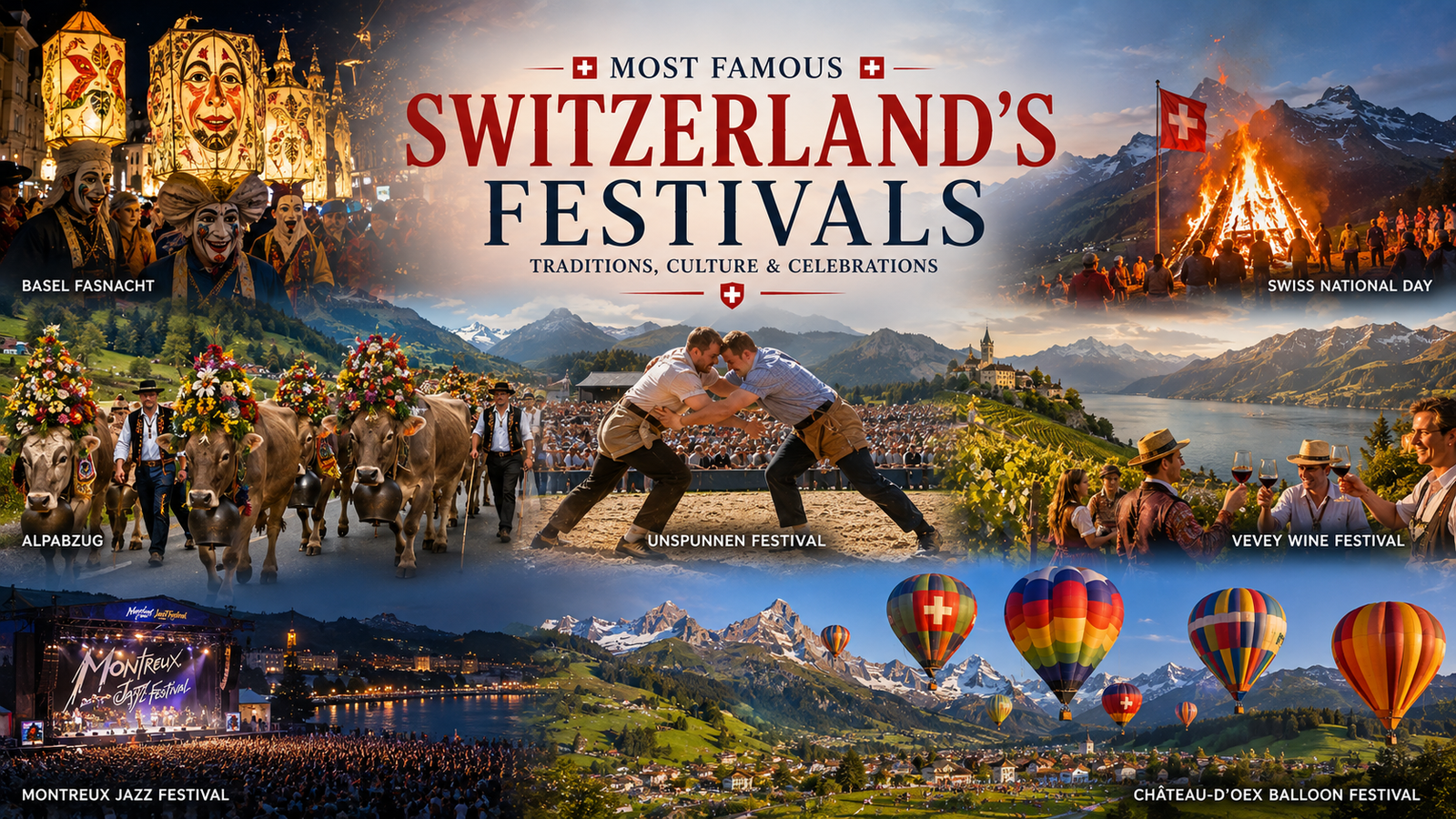
Among all Swiss festivals, Basel Fasnacht is often considered the country’s most distinctive cultural celebration. Recognized by UNESCO as part of the Intangible Cultural Heritage of Humanity, the festival transforms the city of Basel into a stage for music, satire, costumes, and artistic expression.
The event traditionally begins early on a Monday morning with the famous “Morgestraich,” when the city’s lights are extinguished and illuminated lanterns fill the streets. Marching groups, known as Cliques, perform music throughout the city while participants wear elaborate masks and costumes.
Unlike many European carnivals, Basel Fasnacht has developed a unique identity deeply rooted in local history and civic culture, making it one of Switzerland’s most celebrated traditions.
Swiss National Day
Every year on August 1, Switzerland commemorates its National Day. The celebration marks the historical origins of the Swiss Confederation and is observed throughout the country.
Unlike festivals centered in a single city, Swiss National Day is experienced nationwide. Villages, towns, and cities organize fireworks displays, concerts, speeches, community gatherings, and traditional performances. Bonfires are often lit on mountain slopes, creating spectacular nighttime scenes across Alpine regions.
The day offers visitors an opportunity to witness Swiss patriotism expressed through local traditions rather than large-scale national ceremonies.
Fête des Vignerons: A Once-in-a-Generation Spectacle
Held in the wine-growing town of Vevey on the shores of Lake Geneva, Fête des Vignerons is one of the world’s most extraordinary cultural festivals.
Organized by the Confrérie des Vignerons, the festival honors the region’s wine-growing heritage. Unlike annual celebrations, it takes place only periodically, typically once every generation. This rarity contributes significantly to its prestige and cultural importance.
The event combines music, theater, dance, and large-scale performances that celebrate vineyard traditions and the relationship between people and the landscape. Its unique character earned recognition from UNESCO as Intangible Cultural Heritage.
Sechseläuten in Zurich
Each spring, Zurich welcomes warmer weather with Sechseläuten, one of Switzerland’s most recognizable seasonal festivals.
The celebration is famous for the Böögg, a large snowman figure filled with fireworks. During the festival, the Böögg is placed atop a bonfire and ceremonially burned. According to local tradition, the speed with which the head explodes is believed to predict the quality of the upcoming summer.
Alongside this symbolic ritual, visitors can enjoy historical processions featuring guild members dressed in traditional attire, horses, music, and cultural performances that reflect Zurich’s historic identity.
Unspunnen Festival: Alpine Traditions on Display
Held near Interlaken in the Bernese Oberland, the Unspunnen Festival celebrates Swiss rural culture and Alpine traditions.
The event is particularly famous for traditional Swiss wrestling, known as Schwingen, as well as stone throwing competitions and folk music performances. Participants wear traditional clothing, and the festival provides a rare opportunity to experience customs that remain deeply connected to Swiss mountain life.
Although not held annually, Unspunnen remains one of the country’s most important showcases of traditional Swiss heritage.
Locarno Film Festival
Switzerland’s festival calendar is not limited to historic traditions. The Locarno Film Festival, held in the Italian-speaking canton of Ticino, ranks among Europe’s most respected international film events.
Founded in the mid-twentieth century, the festival attracts filmmakers, actors, critics, and cinema enthusiasts from around the world. One of its defining features is the open-air screenings held in Piazza Grande, where thousands gather beneath the night sky to watch films.
Its international reputation has helped establish Switzerland as an important destination for contemporary arts and culture.
Alpabzug and Désalpe: Celebrating Alpine Life
Across various Swiss regions, autumn brings one of the country’s most picturesque traditions: the seasonal descent of cattle from mountain pastures.
Known as Alpabzug in German-speaking regions and Désalpe in French-speaking areas, these celebrations mark the end of the Alpine grazing season. Farmers decorate cows with elaborate floral arrangements and large ceremonial bells before leading them through villages.
The events attract both locals and visitors, offering a vivid reminder of the agricultural traditions that have shaped Swiss mountain communities for centuries.
Geneva’s L’Escalade
Geneva commemorates one of the most significant moments in its history through L’Escalade, a festival honoring the city’s successful defense against an attempted attack in 1602.
The celebration includes historical reenactments, costumed processions, sporting events, and the famous tradition of breaking chocolate cauldrons filled with marzipan vegetables.
L’Escalade combines civic pride, historical remembrance, and festive community spirit, making it one of Switzerland’s most meaningful urban celebrations.
Montreux Jazz Festival
Set against the stunning backdrop of Lake Geneva, the Montreux Jazz Festival has evolved into one of the world’s most prestigious music events.
Since its founding in 1967, the festival has welcomed legendary performers from jazz, rock, blues, pop, and many other genres. Although its name emphasizes jazz, the event has become known for its broad musical diversity.
Its lakeside setting contributes to an atmosphere unlike any other major music festival, attracting visitors from across the globe each summer.
International Balloon Festival in Château-d’Oex
High in the Vaud Alps, the village of Château-d’Oex hosts one of Switzerland’s most visually spectacular events.
During the International Balloon Festival, colorful hot-air balloons rise above snow-covered mountain landscapes, creating breathtaking scenes that draw photographers and travelers from around the world.
The combination of Alpine scenery and aviation tradition has made the event one of the most distinctive winter festivals in Switzerland.
A Country Celebrating Many Identities
What makes Swiss festivals particularly fascinating is their diversity. In a single year, travelers can experience medieval commemorations in Geneva, vineyard celebrations on Lake Geneva, Alpine cattle parades in mountain villages, international cinema in Locarno, world-class music in Montreux, and centuries-old carnival traditions in Basel.
These events reveal a country where local identity remains strong, cultural heritage is actively preserved, and regional traditions continue to thrive alongside contemporary artistic expression. For visitors hoping to experience Switzerland beyond its landscapes, attending a festival often provides the most authentic and memorable connection to the country’s people, history, and culture.